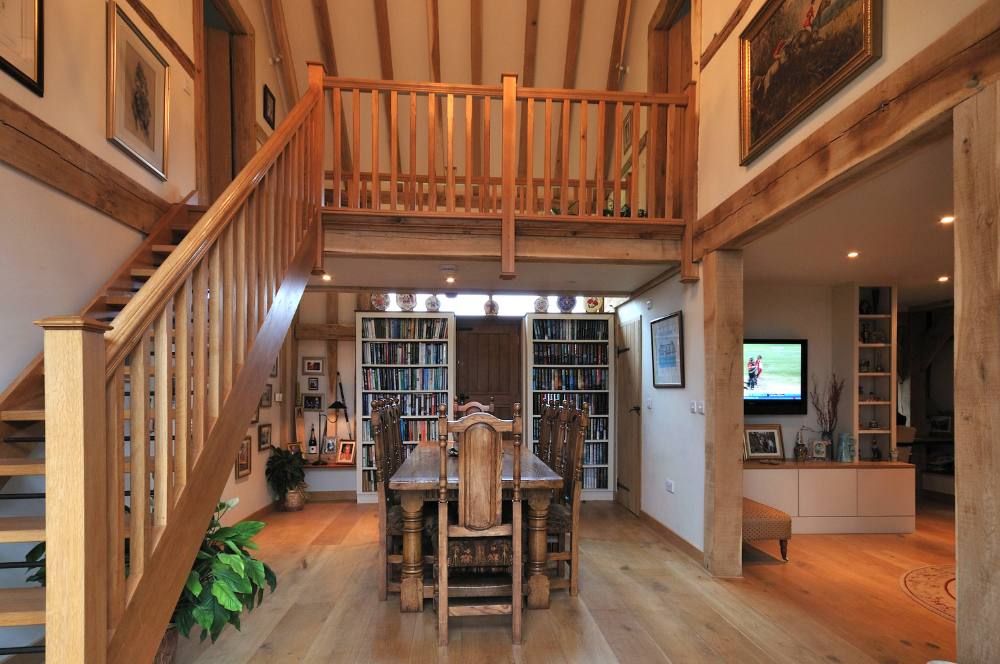
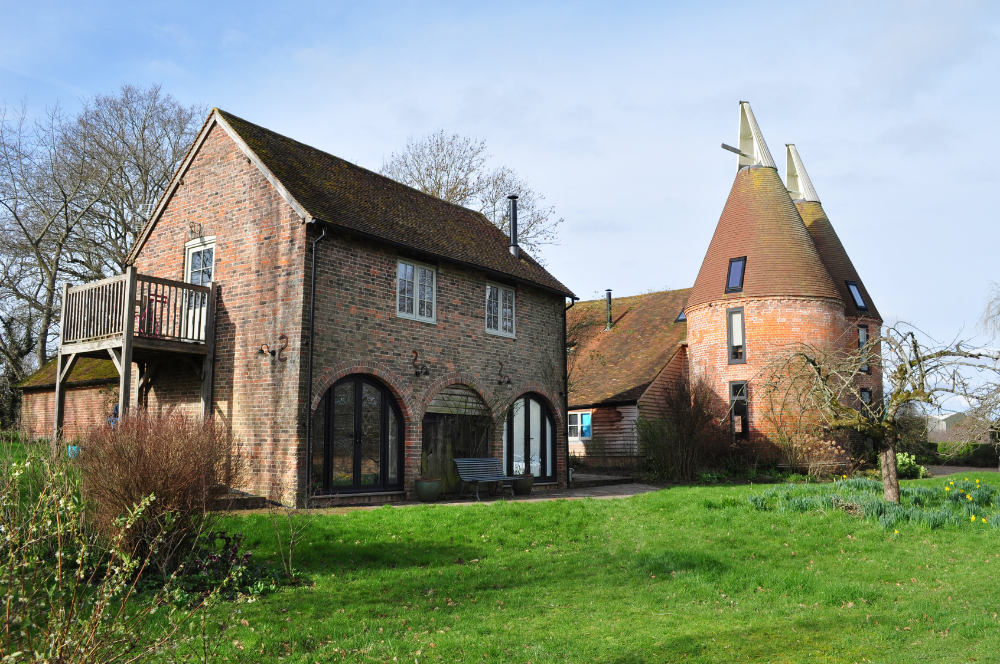
“Taking a client’s ideas and vision and turning it into a beautiful home that not only works for them but preserves the barn, is what we really love to do. Our clients live in their barn conversions for many years to come.”
Oliver Burgess, Managing Director
Read about some of our barn conversions and hear what their owners say…


Transforming a barn and giving it a new lease of life after its agricultural use has ended creates a fantastic opportunity to design an amazing new home.
They’re lived in very differently to how they were worked in; rely on our experience as barn conversion specialists with many successful projects in our portfolio to give you innovative and inspirational design ideas.
Converting a barn requires a methodical approach, and most importantly, experience. Structurally, approaches will need to be tailored to each individual barn, whether it is a historic timber framed or masonry building, or a modern steel or concrete portal framed building.
We’ll look to keep its heritage alive, incorporating original features where possible whilst designing a home that suits how you live, with the design and look you want – modern, contemporary or traditional.
Barns require a few different considerations to other homes – light is an important factor and our designs will look at position of rooms, flow and windows to use both the space and light well.
Kent, Sussex and Surrey have some of the most beautiful timber-framed agricultural structures in all of England. The most common barn type is the threshing barn – a large, almost two-storey structure, often timber frame and weatherboarded on a brick or stone plinth. The roofs in the Weald of Kent and downland, are often tiled, slated and occasionally thatched.
Converting a traditional barn makes a great home and the success in the design process is innovative use of the existing space, large glazing areas in the central midstrey (porch/entrance) threshing bay and well-proportioned double-height spaces.
“Because the property is listed, there were many restrictions on what could be done. Vernacular’s advice and ideas helped us to make our dreams come true.”
Modern steel or concrete portal frame barns, many of them built in the last 70 years or so, usually have large spans and are typically used for housing livestock or farm machinery. Turning these structures into homes requires expertise and imagination.
Many of these barns are being converted following amendments to planning policy in 2013, often referred to as ‘Class Q’.
Class Q was introduced as part of the General Permitted Development Order in 2013 allowing barns in agricultural use to be converted to residential use within certain specific criteria.
This can be a useful way of obtaining consent for modern concrete or steel portal framed barns of the Atcost variety as well, on occasions, as historic timber framed, brick or stone barns.
Many barns do not actually meet the criteria for Class Q but opportunities to convert may still be available – our expertise lies in providing attractive and sensitive designs that meet planning regulation. Before a build starts, planning must be granted, unless the specific circumstances mean that a Class Q prior approval is an alternative route.
Successful, creative, planning applications are what we excel in meeting both the client brief and local authority requirements. Location, the existing building, proposed scheme and structural works all need to be considered, alongside your vision for the new home – we keep this all in mind at every stage.
“We’d already been granted planning permission through an architect but with a number of constraints. Trevor helped us take the project forward, discharging all the conditions and adapting the design.”
We use BIM (Building Information Modelling) to give you a virtual walkthrough of both inside and outside of the newly designed residential barn – which can be changed in real time to explore design options and planning solutions. In addition, BIM allows us to accurately assess the materials and work required for the actual building works and provide an initial price specification based on the planning drawings.
We work with clients either from the beginning of the planning process, or, often, to develop or revise a previous or inherited planning application or failed planning application, working toward a successful planning outcome to get your build under way.
Find out about our planning services…
Whether your barn is in a conservation area or Area of Outstanding Natural Beauty (AONB), we have the experience to create designs that you will love and local authority planners are most likely to approve without too many adjustments.
We listen, we hear, and we create designs that match our clients’ requirements to provide them with a home that works for them and retains its history and heritage.
“Some people thought we were mad when we first bought the barn, as it was in such bad condition but now, every time someone visits, they comment on how fantastic it looks. This was always intended to be a family home that we could live in for the long term and that’s just what it is.”
Start your barn conversion with a conversation with us…
Take a look at our previous barn conversions and hear from their new owners…
Read Our Brochure
Yes – either full planning or partial planning, through Class Q.
Most barn conversions can proceed under Class Q permitted development rights, which allows agricultural buildings to be transformed into a home without full planning permission.
There are some exceptions to this though – if the barn is listed, located in an Area of Outstanding Natural Beauty (AONB), or within a conservation area, full planning permission is typically required – Class Q can’t be used.
We work across the south east and are familiar with local authority requirements, holding good relationships with planning officers, who are keen to see barns brought back to life with sympathetic restoration.
Read more in our blog about Class Q
Each barn is different – size, location and condition are the most influencing factors to price.
Roughly speaking, average costs typically fall between £2,700 and £3,250 per square metre, but can reach or exceed this upper limit depending on finish, materials and spec.
Again, each barn is different, but the minimum is 9 months, but will depend on many things – designs and planning (although we only ever submit plans that we know will have a high chance of being accepted), material availability, weather, structural work, or restoration – a barn that needs a new roof for example, will be a longer build.
Realistically, allow 11-13 months.
Yes, they can, and we have worked on many steel-frame conversions, incorporating the original frame into the design and where possible, leaving the steel frame exposed.
Take a look at two of our projects here:
Steel reinforced concrete portal framed building – now a luxury holiday let
https://www.vernacularhomes.com/our-work/barn-conversion-south-east-kent/
A corrugated and timber-clad steel framed outbuilding is now a comfortable home
https://www.vernacularhomes.com/our-work/barn-conversion-west-kent/
Each build comes with its own challenges – and it doesn’t automatically mean they add time or require more budget.
We’re used to a few bumps in the road and can usually predict most of them, but can also deal with them as they arise.
Some of the challenges we have faced have included making the barn structurally sound – and sometimes, not much of the original timber or steel is left, but we preserve what we can and weave it into design where we can, keeping it visible.
Bats, asbestos, the discovery of a stream and hold-ups with suppliers providing bespoke windows, glazing or other elements have all cropped up in the past, but we know how to deal with them and also know how to re-jig the schedule to keep us moving towards the completion date.
Here are a few more:
Client dreams versus restrictions – sometimes, not everything is possible due to budget, what will be passed by planning or what will work in terms of structure. We always end up finding a way through to a design our clients are happy with.
This client wanted a separate driveway – which was initially turned down by the local authority planning officers, but with a revision and a chat with them, it went ahead.
https://www.vernacularhomes.com/our-work/barn-conversion-east-sussex/
To help with a future sale, we split this barn from the neighbour’s property.
https://www.vernacularhomes.com/our-work/barn-conversion-west-kent-2/
Matching materials can sometimes be tricky, if we’re looking for specific roof tiles or bricks, for example.
Take a look at this project where we rebuilt the walls with the existing bricks, in the same Flemish garden wall bond brickwork.
https://www.vernacularhomes.com/our-work/five-property-farmstead-conversion-planning-west-kent/
Flooding – sometimes, we need to level or raise floors to change the barn into for cattle to fit for humans! Here’s one project where we did this:
https://www.vernacularhomes.com/our-work/barn-conversion-surrey-2/
Preserving a barn’s historical features is often a priority in conversions. Vernacular Homes specialises in designs that retain original elements like timber frames and brickwork, blending them with our clients’ lifestyle and layout ideas.
Yes – they can be lived in or let out to tenants or guests.
Take a look at this luxury holiday let, or at the 5 properties we converted on the Linton Park Estate for rental to tenants.
Traditional timber-framed barns, oast houses, granaries, and even modern agricultural buildings can be suitable for conversion, depending on their condition and location. Vernacular Homes assesses each structure’s potential and advises on the best approach, budget, considerations and timescales.
Get in touch – let us know about a barn that you are thinking of converting, renovating or refurbishing, or show us one that you are thinking of buying.
For an informal conversation about your project please call us on 01233 861177 or email us using the form. Your data is not used for marketing – only to contact you.

If you have documents - previous designs, plans or photos, please send them to us via email: enquiries@vernacularhomes.com